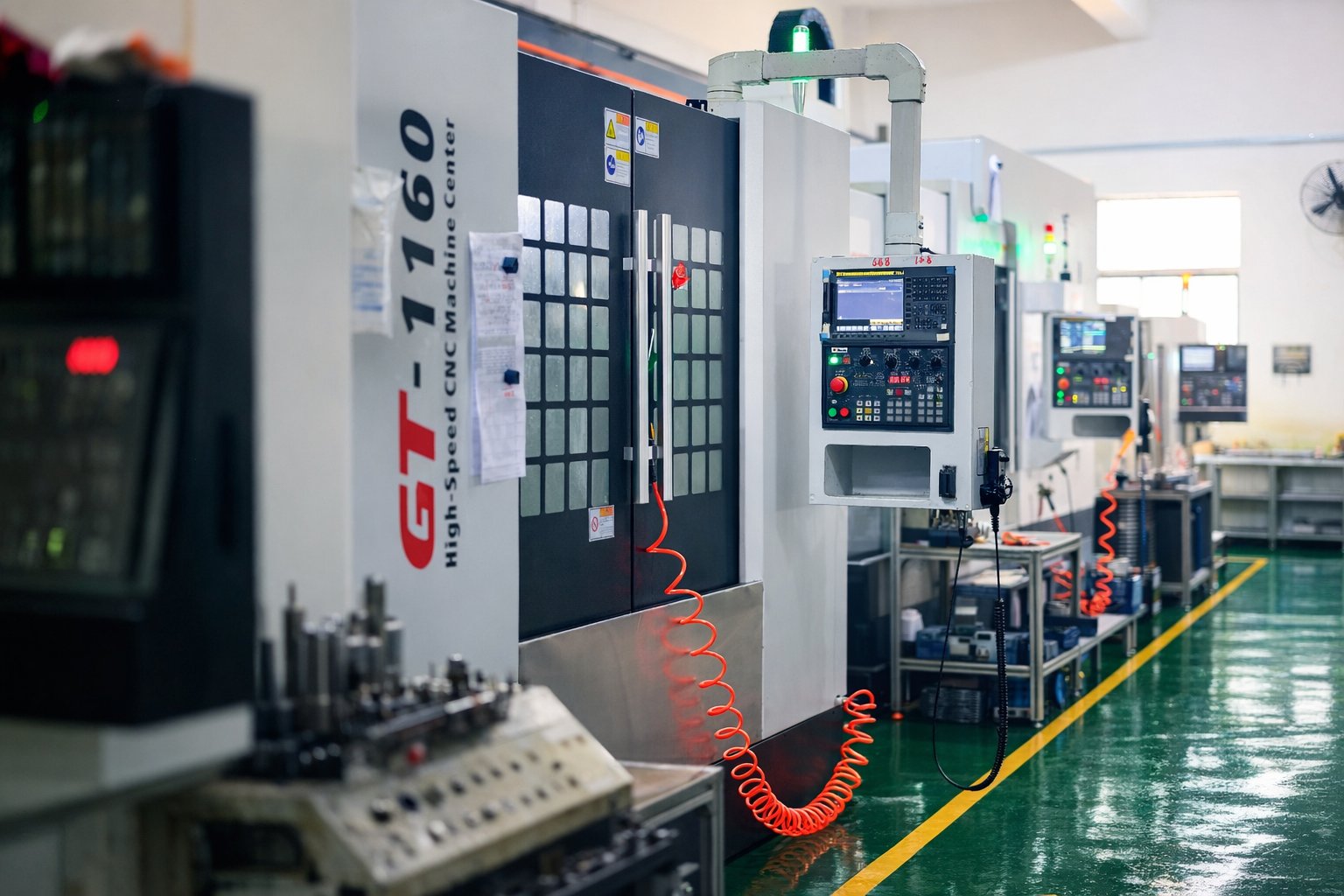
When two shops quote the same part and the numbers come back far apart, it usually isn't because one is overcharging. A CNC price is built from a handful of real cost drivers, and small choices on your drawing move each of them up or down. This article sets out exactly what we account for when we price a part, and where you have the most leverage to bring the number down.
The cost drivers, plainly
Material choice and stock size. You pay for the full block of metal we start from, not the lighter finished part. So a part that fits a 100 mm bar costs less in raw stock than the same part forced up to a 120 mm bar by a single oversized flange. Aluminium (6061, 7075, 6082) is the material we machine most often, and usually the most economical; stainless (316, 17-4PH), titanium (Ti-6Al-4V) and PEEK cost more on both counts, in the raw stock and in the cutting time required.
Part complexity and feature count. Every pocket, hole, slot and tight corner adds cutting time. A simple bracket might be 10 minutes of spindle time; a dense manifold full of cross-drilled ports can run hours. What drives the clock is feature density, how much detail is packed into the part, not how big it is. A telling example: a perfectly sharp internal corner can't be milled at all, because a round cutter can never reach into a square corner. It forces a slow secondary process (wire EDM), whereas a small R1 or R2 corner radius lets a standard cutter do the whole job.
Tolerances and surface finish. This is the single most common place buyers overpay. A general tolerance (ISO 2768-m, the standard machining band) comes straight off the machine at no extra cost. A tight tolerance, by contrast, buys an extra finishing pass, more inspection, and a higher chance of scrapping the part. Surface finish works the same way: down to roughly Ra 1.6 (a normal machined finish) is essentially free, but a mirror-polished Ra 0.2 face can cost more than the machining itself. Tighten every dimension and the same part can run several times the price of the general-tolerance version, so call out tight tolerances only on the features whose function genuinely requires them.
Material removal volume. Turning 90% of a solid billet into metal chips is both slow and wasteful of stock. A skeletal part, mostly empty space around a thin web, takes far more cutting than a compact, solid part of the same overall size, even though it weighs less.
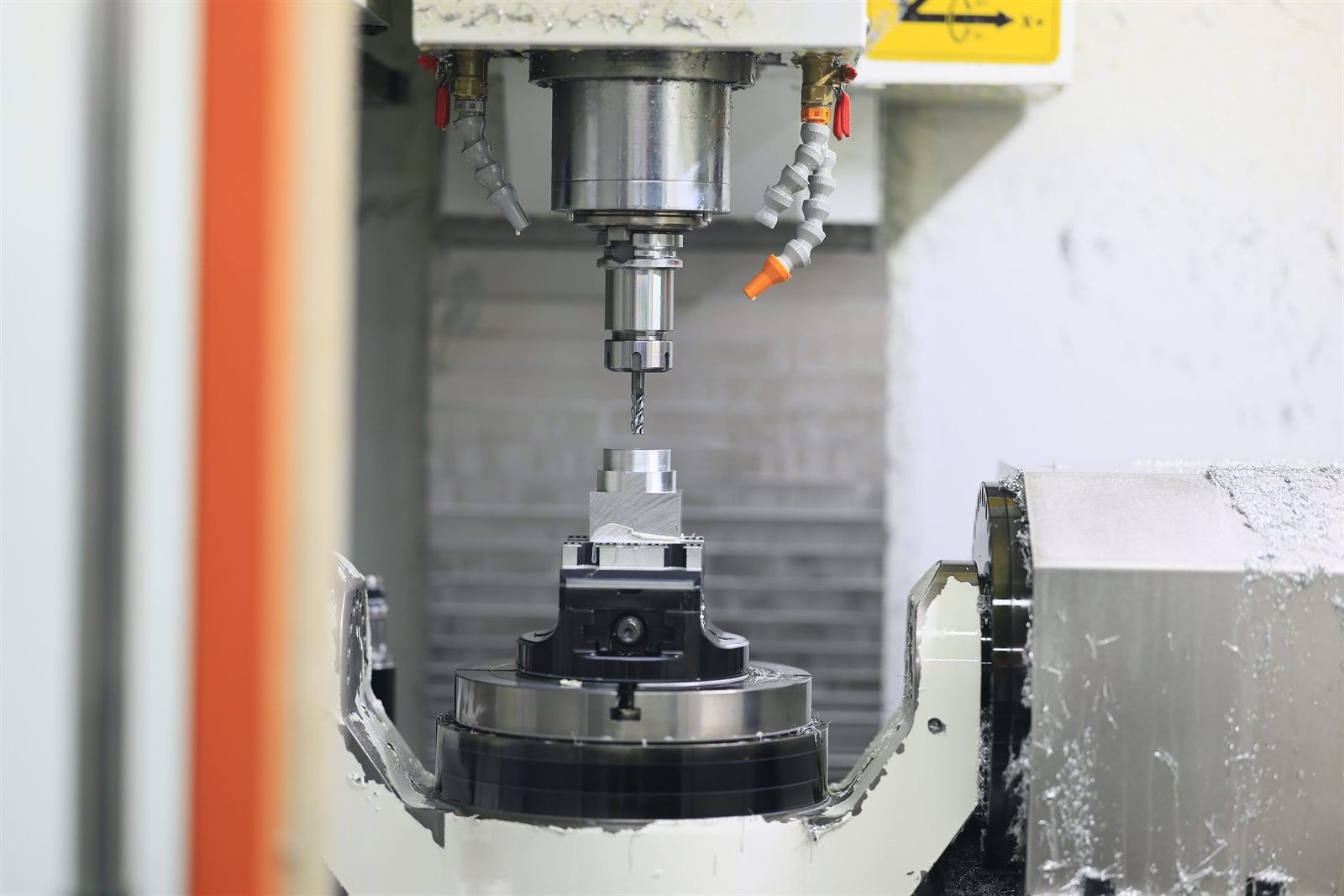
Fixturing and number of setups. Every time the part is re-clamped to expose a new face, that counts as another setup: another round of alignment, more labour, and one more chance for small errors to stack up. This is where our 5-axis machines add the most value. Reaching more faces in a single clamping means fewer setups, less labour, and tighter feature-to-feature accuracy.
Secondary operations and inspection. Finishing steps like anodizing, plating, bead blast, heat treatment and passivation each add a process step, a minimum lot charge, and extra lead time. Inspection works the same way: a part where every dimension is flagged critical, or that needs a full dimensional report, carries real measuring labour. So ask only for the finishes and documentation the part actually needs.
Quantity is the lever
The one-time cost of programming, fixturing and first-article inspection is the same whether you order 1 part or 100. Order a single piece and that whole setup cost lands on it alone. Spread it across a batch and the per-part price drops steeply at first, then flattens out as cutting time and material take over as the main cost.
| Quantity | What you mostly pay for | Per-part trend |
|---|---|---|
| 1 (prototype) | All setup and programming carried by one piece | Highest |
| 5–20 | Setup spread thinner; some material savings | Drops fast |
| 50–200 | Mostly cutting time and material | Flattens |
| 500+ | Cutting time, material, finishing all run in lots | Lowest, near the floor |
For the full pricing picture, one-time costs versus per-part costs, why a single piece costs more, and how lead time scales with quantity, see how a CNC part is priced.
7 ways to cut cost without losing function
- Loosen non-critical tolerances. Put tight tolerances only on features that mate, seal or carry load, and leave everything else at ISO 2768-m. This is by far the biggest lever.
- Use standard stock sizes. Design around common bar and plate dimensions so we aren't buying an oversized billet just to clear one feature.
- Avoid deep narrow pockets and thin walls. Walls thinner than about 0.5 mm chatter and flex under the cutter, and a pocket deeper than 4–6× the tool diameter needs a slow, special long tool. A small radius or a support rib usually solves it.
- Accept standard finishes. As-machined or a standard clear anodize costs far less than a matched custom colour. Specify a cosmetic finish only on the faces that are actually seen.
- Batch your quantities. If you know your annual usage, order in fewer, larger releases so the programming, setup, any custom fixture, and the trial stock are paid for once rather than on every order. Tell us your estimated annual usage (EAU) and we'll price accordingly.
- Design for fewer setups. Group features onto as few faces as practical. Fewer re-clampings means less labour and better feature-to-feature accuracy.
- Send a clear drawing. A 2D drawing with a general-tolerance note, clearly flagged critical dimensions, and a finish callout lets us price it accurately the first time, without back-and-forth clarification and without margin added to cover unknowns.
Key takeaways
- Material, cutting time, tolerances, finish, quantity and inspection are the real cost lines, not arbitrary markup.
- Tolerance and surface finish are where buyers overpay most often, so spend tight callouts feature by feature, not across the whole part.
- Setup cost is fixed per order, so quantity is the single biggest lever that pulls the per-part price down.
- A clear 2D drawing gets you an accurate, unpadded quote within 48 hours.