
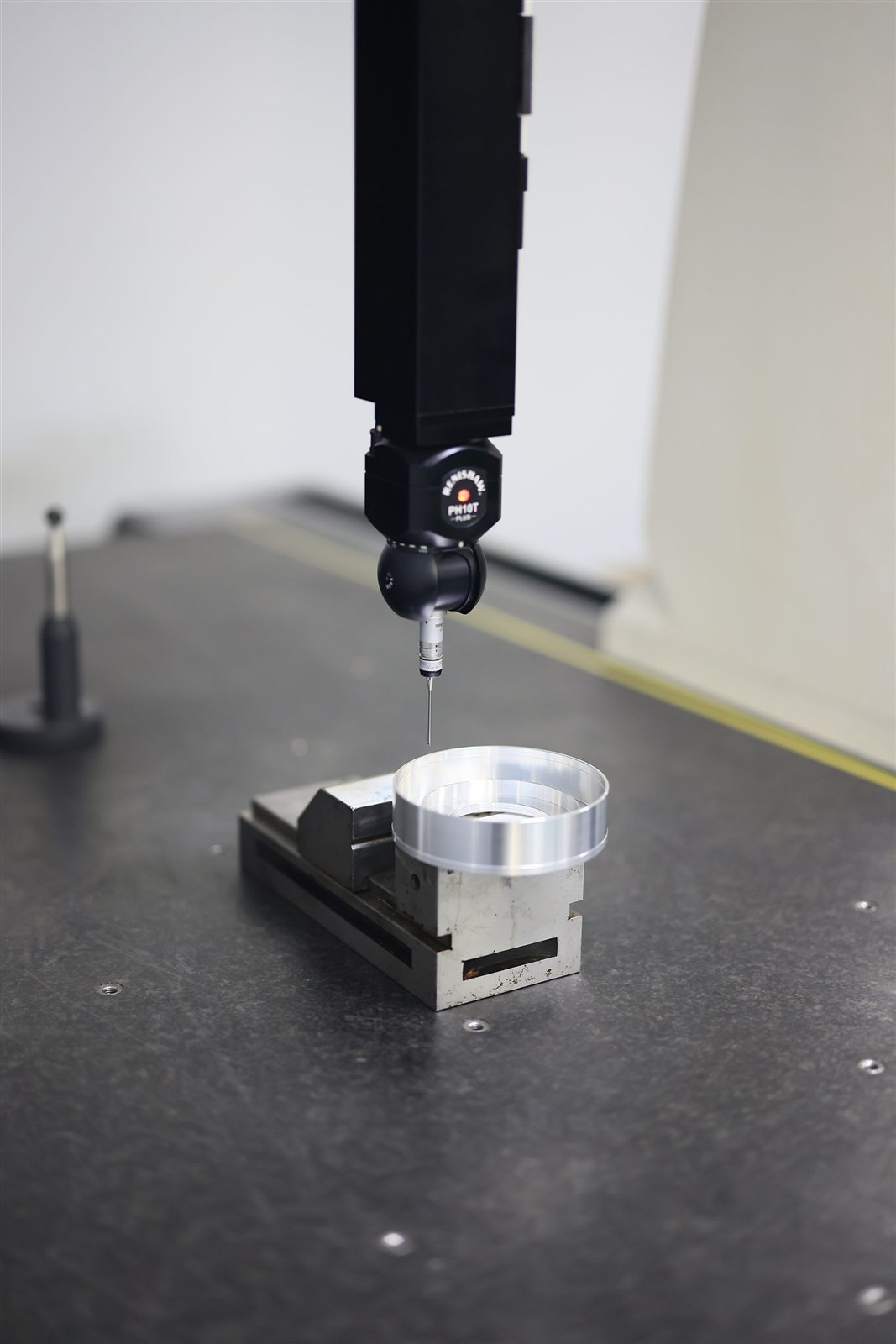
A tolerance defines how far a dimension may deviate from its target before the part is rejected. Tighter tolerances buy a better fit but cost more, and most parts do not need them on every feature. This guide explains where to invest precision so it delivers real value.
What ISO 2768 is. It's the standard that sets general tolerances — the catch-all allowances that apply to every dimension you don't tolerance individually on the drawing, so you don't have to label each one. (Part 1 covers linear and angular dimensions; Part 2 covers geometric form.) We machine to 2768-m (medium) by default, which strikes the right balance for most features.
ISO 2768-m, linear dimensions
| Nominal length (mm) | Permitted deviation (± mm) |
|---|---|
| 0.5–3 | 0.1 |
| over 3–6 | 0.1 |
| over 6–30 | 0.2 |
| over 30–120 | 0.3 |
| over 120–400 | 0.5 |
| over 400–1000 | 0.8 |
The -f "fine" class is tighter and -c "coarse" is looser; angular tolerances and chamfers have their own tables in the standard.
When to go tighter
Specify a tighter tolerance where the dimension performs a functional role — press and slip fits, bearing seats, sealing faces, and any feature that mates with another part. On those we hold down to ±0.005 mm on request; simply flag the dimensions on the drawing.
Why tighter costs more
Holding a tight tolerance means extra finishing passes, slower cutting, more inspection, and a higher scrap rate — and that cost repeats on every dimension you tighten. Across a whole part it compounds quickly: machined tight everywhere, the same part can cost up to ten times what it would at general tolerance (ISO 2768-m). Reserve tight tolerances for the features whose function genuinely requires them.
How to call it out on your drawing
CRITICAL (flagged): ⌀12 H7 · FLATNESS 0.02
Apply tight tolerances and GD&T (geometric dimensioning and tolerancing — the symbols that control a feature's form and position) only where they're needed, and let ISO 2768-m govern everything else. That way you pay for the precision you need and skip the precision you don't.
Three common mistakes
- A blanket tight tolerance on every dimension — most features don't need it, and you pay the premium on all of them.
- No general-tolerance note at all — leaves us guessing and forces a padded quote.
- Treating ±0.005 mm as the default — it is a per-feature capability available on request, not a baseline applied automatically.