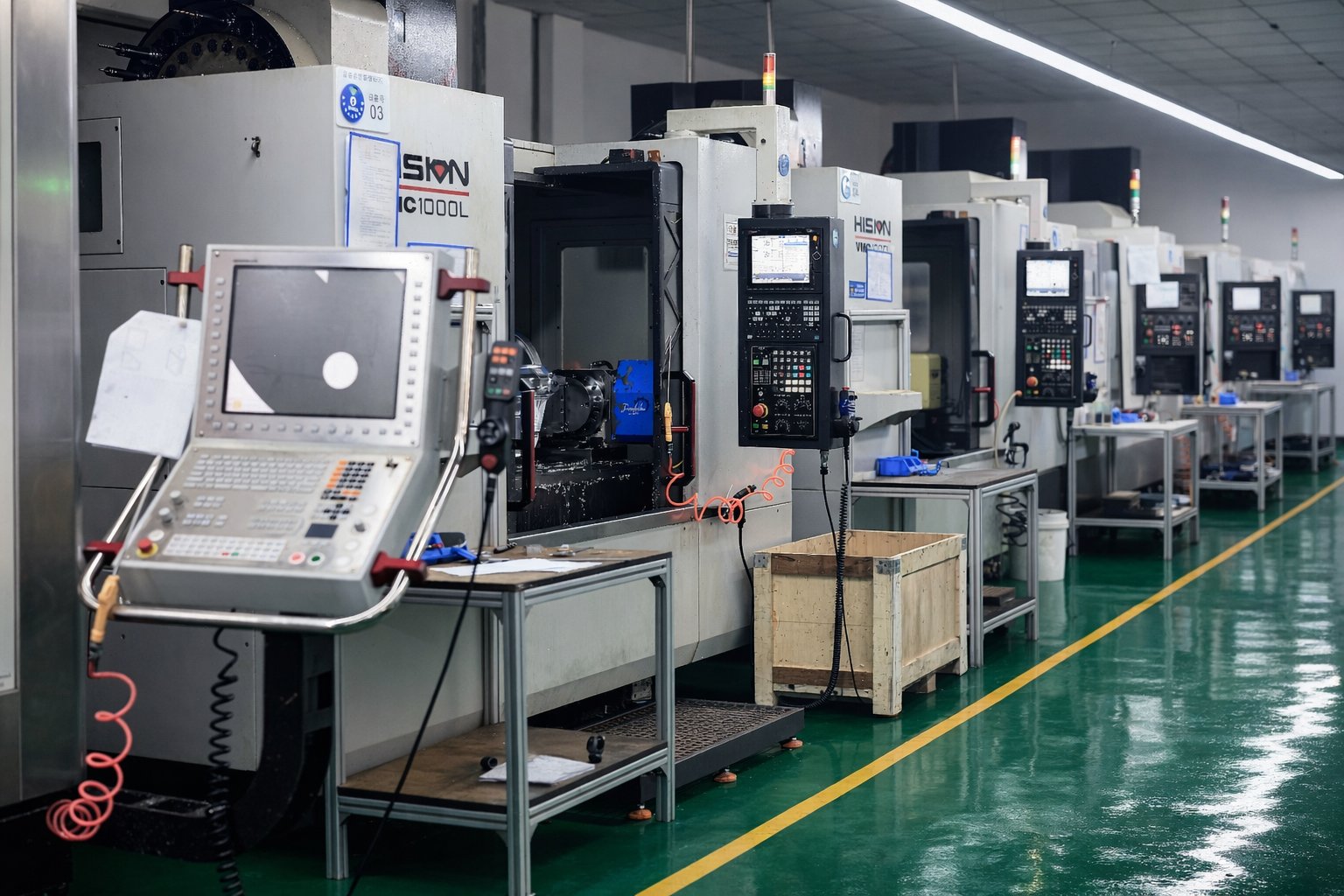
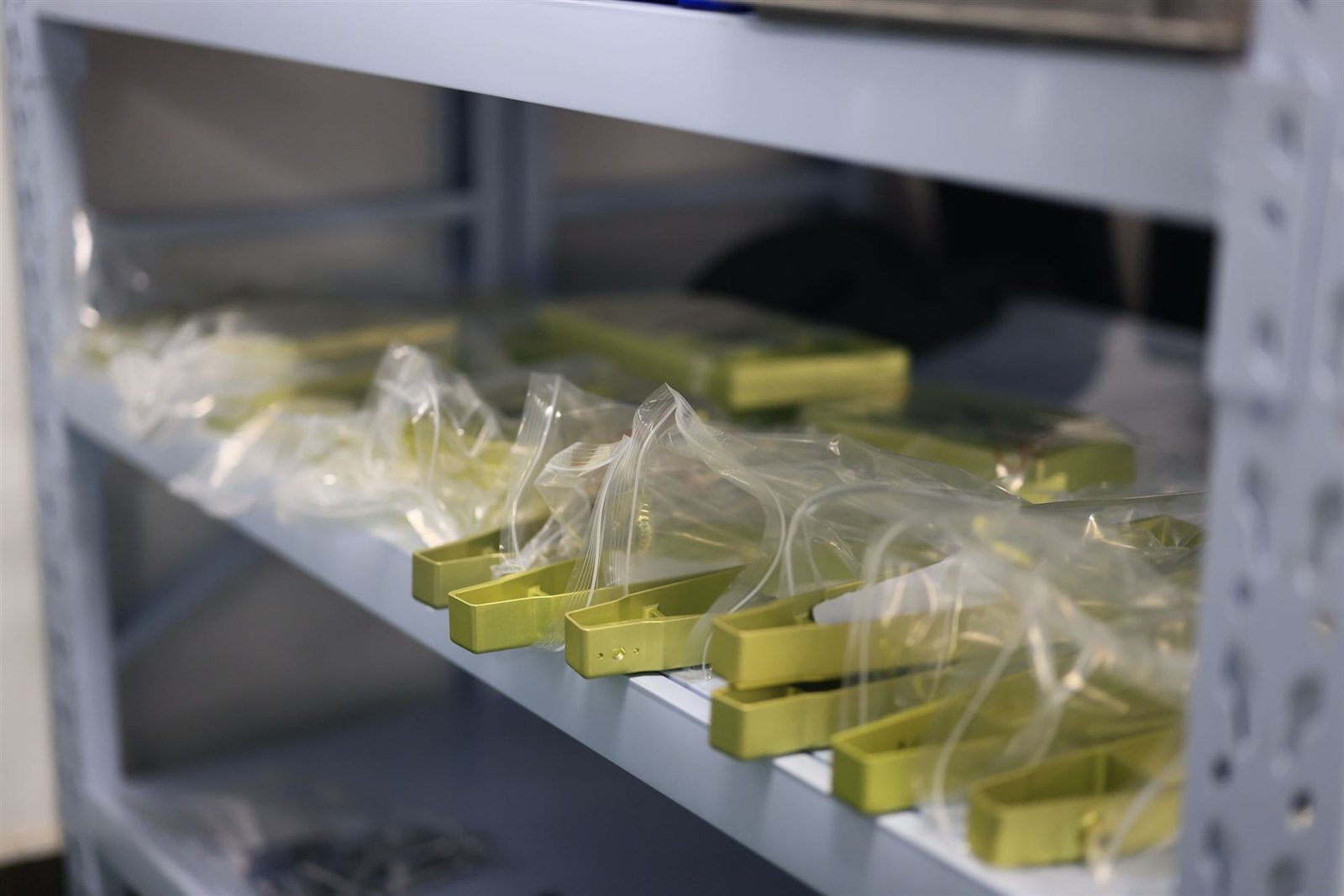
A quote isn't a single number. It is a set of one-time costs to produce your first good part, plus the cost to make each piece after that. Once both halves are clear, low-volume pricing and lead times become predictable — and you can see exactly which levers bring them down.
The one-time costs (they don't change with quantity)
Every new part carries costs that you pay only once, no matter how many you order: writing the machining program, setting up and dialing in the machine with trial cuts, building a custom fixture to hold many shapes, and the extra blank or two of raw material those trials consume. Spread over hundreds of pieces, they vanish into the unit price; on a run of one or two, they are most of the bill. Same part, higher quantity, lower price per piece.
- CAM programming. Each new shape needs its own machining program — the toolpaths the cutter follows, plus the right speeds and feeds — written from scratch before a single chip is cut.
- Setup and tuning. The part is clamped, aligned, and the cut refined with trial runs until the first piece measures within spec.
- A custom fixture. Many shapes can't be gripped in a standard vise, so we machine a dedicated holding fixture in-house.
- Trial stock. An extra blank or two of raw material to absorb the tuning cuts, required even on an order of one.
Dialing in a new setup — programming plus trial cuts — can take a full shift before the first good part comes off the machine. Once it is running, that same shift can produce dozens of parts. This is why the first piece carries a cost the hundredth does not, and why the per-part price falls so steeply as quantity climbs.
Surface treatments — anodizing, plating, powder coat, passivation — run as a batch and carry a minimum lot charge: a flat fee to set the line running, regardless of how many parts go through. Coating one part costs nearly as much as coating ten, because the line processes a whole batch either way. Like a fixture, that charge spreads thin over a large order and lands hard on a single piece.
The per-part costs (they scale with quantity)
Machining time tracks how much detail the part has: every pocket, hole, slot, and tight corner is more time under the cutter. Material is the block each part is cut from, priced per piece. Finishing adds its per-part share once that lot charge is covered. And inspection scales with what you ask for — request the documentation you actually need, not a full report on every dimension by default.
Not every process scales the same way
Two finishes can scale in opposite directions. Bath finishes like anodizing all share one tank, so a bigger batch mostly costs more chemistry, not more labor — ten parts or a thousand, the labor per part barely moves. Hand finishing is the reverse: polishing a complex shape full of edges and corners is done by hand, one part at a time, so a thousand parts is close to a thousand times the work. (A simple bar can be polished on the machine in a single pass; an intricate shape has to be worked by hand.) Labor-heavy finishes don't get cheaper with volume; batch finishes do.
Some finishes — chrome plating, nickel plating, powder coat, black oxide — are done by specialist finishing partners we coordinate on your behalf, so you still deal with just one supplier. On a small order, each finish ships out as its own small batch, carrying that partner's minimum charge and freight both ways; a more specialized finish may go to a shop further afield, adding a little to cost and lead time. We can deliver the finish you require; it is worth noting that several different finishes spread across a few parts carry more of this overhead than a single finish on one larger batch. Chrome is the clearest example. It comes in two kinds, each from a different specialist: decorative chrome for a bright, cosmetic look, and functional chrome, a harder plating built for wear resistance. Decorative chrome in particular may travel out of province, which adds to both cost and lead time.
Why one part costs more per piece
Put the two halves together and low-volume pricing explains itself. The one-time costs are the same whether we make one piece or five hundred; only the per-part costs scale with quantity. At quantity one, that entire setup lands on a single part. At a few hundred, it fades into the unit price. Same part, higher quantity, lower price per piece. It's also why no minimum order is an honest promise: we'll gladly machine one part — it simply carries everything one part includes.
Lead time works the same way
Most of a lead time goes to getting material in and preparing the job, not to the cutting itself. The common grades we stock — 6061 and 7075 aluminium, 304 stainless, and ordinary carbon and alloy steels — are usually ready to cut within a couple of days. A specialty alloy has to be sourced to order, which can add a week or more. So if your application allows a common grade, choosing one is usually both cheaper and faster.
Quantity affects lead time less than many expect, because most of the schedule goes into programming, tuning, and fixturing rather than cutting. For example, a run of 200 parts might take 15 days, while a run of 1,000 often adds only a few days more.
The levers you control
- Tolerances. The same part held to tight tolerances everywhere can cost up to ten times what it costs at the general tolerance grade (ISO 2768-m). Call out tight tolerances only where the part's function actually requires them. How ISO 2768 works.
- Surface finish. The same logic applies here: the standard as-machined surface is included, and every step smoother adds real cost — a mirror-polished face can run more than the machining itself. Specify a fine finish only on the faces that need one. The finish guide.
- Sharp internal corners. A milling cutter is round, so it physically can't leave a dead-sharp internal corner — that corner has to be burned in by EDM (electrical discharge machining), a slow, costly second operation. For most parts, an internal radius of R1 or R2 (a 1 or 2 mm corner radius) machines quickly at no extra cost. Ask for a truly sharp internal corner only when your design genuinely needs one. DFM basics.
The bottom line
There is no minimum order: we will machine a single part, and the price reflects exactly what one part includes. For the most accurate quote, send a 3D STEP file plus a 2D PDF with tolerances, your quantity, and a target price if you have one. See exactly what to send, or request a quote now.