DFM review
- Geometry & tool access
- Internal corners & radii
- Deep features & thin walls
- Assembly fit
Engineering support
Every quote includes a free DFM review by the engineers who will actually make your part, inside the same 48-hour window. Cost, risk and tolerance issues are flagged before metal is cut.
What this is
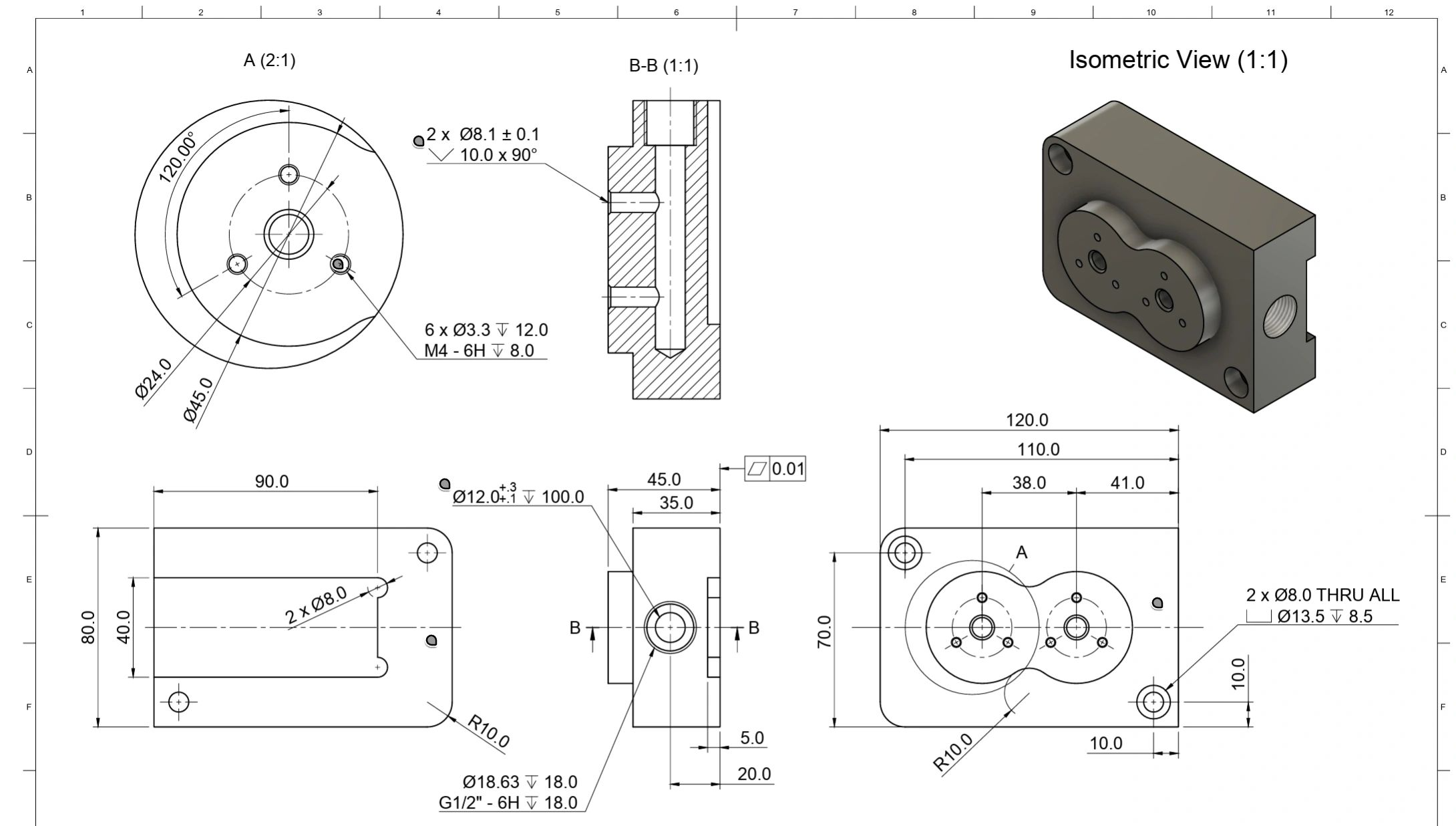
Send a drawing to Fenva and a production engineer reads it before anyone prices it. The review is free, and it happens inside our standard 48-hour quote window, so you never trade speed for scrutiny. If we see a way to make your part cheaper, faster or more reliable, it comes back in writing alongside the price.
Our engineers work natively in STEP, IGES, X_T (Parasolid), SLDPRT and fully dimensioned 2D PDF, so you can send whatever your CAD system produces. No conversions on your side, no "please resend in another format" emails. Quotes from 2D alone are estimates until we see the model; tolerances live on the drawing. Send both and the quote you get is the price you pay.
Files are handled NDA-first. If you want a mutual NDA in place before anything is shared, ask and we sign it before you upload a single file. The same review process runs for everything we machine, from commercial aerospace and UAV structures to components for medical and lab equipment.
What we review
The checklist
| Check | What we look at | Why it saves you money |
|---|---|---|
| Machinability and material fit | Is the specified material right for the job, and is there a cheaper grade that meets the same requirement | Material drives both stock cost and cycle time |
| Tool access | Can a cutter physically reach every feature, and in how many setups | Unreachable features force special tooling or a redesign |
| Internal corner radii | Inside corners sized to standard tool radii, or given a corner relief | A dead-sharp internal corner forces slow, costly EDM |
| Wall thickness | Thin walls and tall unsupported features | Below about 0.5 mm in metal, walls chatter and distort |
| Hole depth | Depth-to-diameter ratios beyond about 4 to 6× | Deep holes deflect tools and trap chips |
| Thread specs | Standard sizes and classes, thread depth, bottoming threads | Non-standard threads add tooling cost and lead time |
| Chamfers near walls | A chamfer running into a shoulder cannot reach the edge; the cutter needs back-out clearance | We flag the small un-chamfered stub before you find it on a first article |
| Tolerance realism | Which dimensions are truly critical, and which can relax to ISO 2768-m | You pay only for the strict tolerances the part actually needs |
| Finish callouts and dimension growth | Anodise and plating thickness against toleranced dimensions | Hard anodise grows a dimension; we confirm fits still work after finishing |
In practice
Material guidance
A pattern we see often: stainless steel specified on a part that carries no structural load, usually for the look or out of habit. Stainless is slow to cut and hard on tooling. When the real requirements were appearance and corrosion resistance, we re-engineered one customer's part in chrome-plated aluminium that matched the look exactly and cut the per-part cost from about €120 to about €40 — over 65% — with full corrosion resistance.
Tolerances get the same treatment. The same part machined to tight tolerances everywhere can cost up to ten times what it costs at general tolerance (ISO 2768-m). Mark tight tolerances only where the function needs them. Our DFM review flags the big cost drivers when we spot them, but we can't audit every callout on every print. The fastest savings come from a pass over your own drawing: does each tight tolerance, fine finish and sharp corner earn its place?
Read the full case studyRepresentative example; actual savings depend on the part, material and quantity.
More than DFM
A welded frame often hides several simple machined parts. Where it helps, we advise on splitting a weldment into components that machine economically and bolt or pin together. Flatness and batch consistency usually improve along with the price.
We recommend the process the geometry wants: prismatic parts to milling, rotational parts to turning, long small-diameter parts to Swiss-style turning, and sharp internal corners or hardened features to EDM. When a small design change moves your part to a cheaper process, we say so.
Quantity changes the right answer. For prototypes we deliberately start extra blanks, so a single scrapped part never resets your lead time. For production we show you the price breaks at quantities like 10, 100 and 500, so you can pick the band where the unit economics work. Asking for a quantity ladder with your quote costs nothing.
The process
STEP, IGES, X_T, SLDPRT or 2D PDF, by email or the quote form. Want an NDA first? Ask, and we sign first.
A production engineer checks every point on the list above against our machines and tooling. The person reviewing your part is the person planning how to make it.
If we see a saving or a risk, it is written in plain language next to the price: what to change, why, and roughly what it saves.
We never change geometry on our own. Accept a suggestion and we re-quote it; decline and we machine exactly what your drawing says.
Mini-FAQ
It is free, and it does not slow anything down. An engineer has to read your drawing to price it anyway, so the manufacturability check rides along at no charge, inside the same 48-hour window.
STEP and IGES are ideal. We also open X_T (Parasolid) and SLDPRT natively, and we can quote from a fully dimensioned 2D PDF alone. The fastest path to an accurate quote is a 3D model plus a PDF marking the critical tolerances.
Never. DFM suggestions are exactly that, suggestions. Every proposed change comes back in writing with its cost impact, and nothing is machined until you approve the revision or tell us to build to the original.
Often, yes. Welded fabrication itself is outside our process, but many weldments split naturally into machined components that bolt or pin together. Send the model and we will tell you whether a machinable split makes sense, at no charge.
Get started
Send your drawings and our engineering team will review manufacturability and quote within 48 hours, no obligation.
NDA on request, signed before you share files.